Core Principles
This page is a quick reference for the key principles that guide effective AI-assisted data analysis. We will be referring back to these often; it is imperative these principles are followed when using AI.
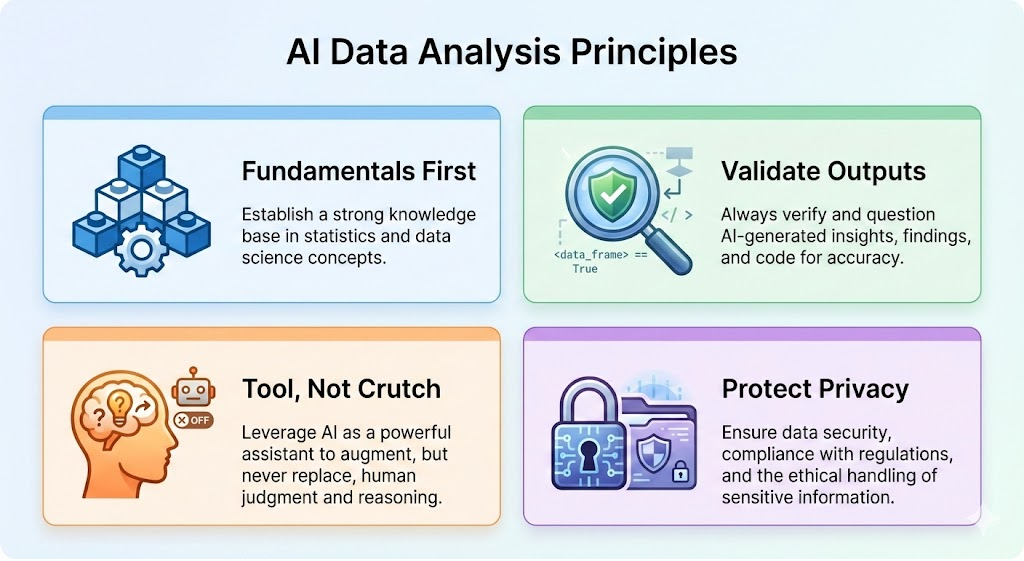
🎯 Principle 1: Learn the Fundamentals First
AI can generate code quickly, but without understanding Pandas, Matplotlib and data analysis basics, you won’t know if that code is correct or how to fix it when things go wrong.
Build the foundation of skills first, then use AI to amplify your skills and further learn.
We’ll explore this in depth in Fundamentals of Data Analysis.
✅ Principle 2: Always Validate AI Outputs
LLMs predict what code looks correct—they don’t test it or understand your data. They can hallucinate functions, produce incorrect logic, or make wrong assumptions. Always read, test, and verify AI-generated code before trusting it.
🤖 Principle 3: Use AI as a Learning Tool, Not a Crutch
The goal isn’t to get code fast—it’s to become a capable data analyst. Use AI to explain concepts, review your code, and help you learn. Avoid using it to skip understanding or offload your thinking.
We cover practical strategies for using AI this way in Learning with LLMs.
🔒 Principle 4: Protect Data Privacy
Never share sensitive, personal, or confidential data with LLMs. Instead, describe your data structure or use dummy data. Be aware of terms of service and what happens to your inputs.
For comprehensive privacy guidelines, see Practicing Responsible AI.
✍️ Prompting Techniques
Beyond these core principles, effective AI collaboration requires good prompting skills. The Writing Prompts section covers:
- Building Better Prompts — Being detailed, specific, and avoiding ambiguity while specifying libraries and breaking problems into steps
- Guiding AI Behavior — Using personas, adapting to your skill level, and using pseudocode to guide structure
- Working with AI Responses — Iterating, including test cases, and validating outputs after you receive responses
- Data Science Examples — Practical examples for data analysis workflows and Pandas/Matplotlib-specific patterns
- Tips & Tools — System prompts, privacy considerations, and quick references
Use this page as a checklist when working with AI:
✅ Do I understand the fundamentals?
✅ Have I validated the AI’s output?
✅ Am I learning, not just copying?
✅ Is my data safe to share?
✅ Would I be comfortable explaining my code with teachers, family or friends?